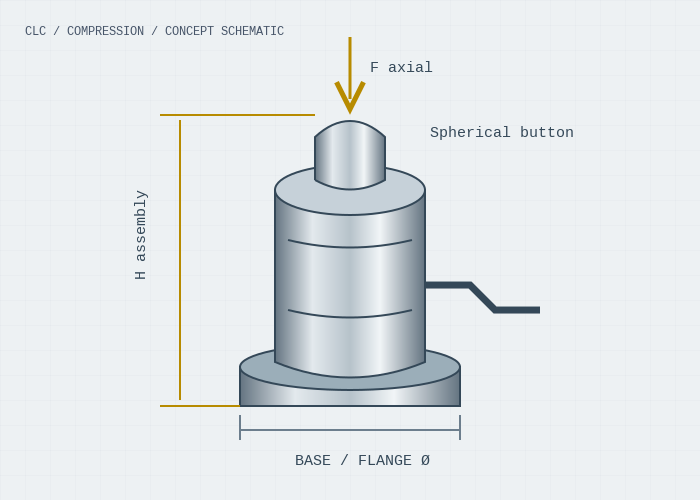
5–100 t
Flat-base compression canister load cells
Axial compression sensing for press monitoring, industrial test fixtures and structural weighing where a fixed base and controlled force introduction suit the machine.
Review load cell configurationSpecify flanged compression canister load cells for pile static testing, hydraulic jacks, heavy presses and structural lifting measurement.
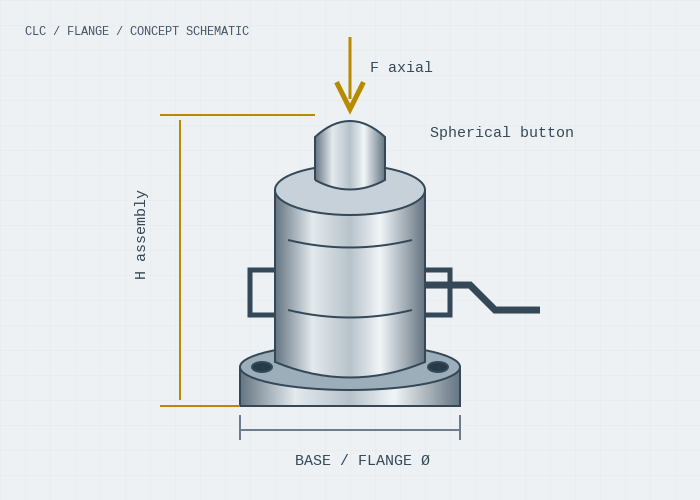
Requested high-capacity steps are 100, 200, 300, 500 and 1,000 t; the fixed-base CLC-CMP family also covers 5–100 t enquiries. A 2300 high capacity flange mount column load cell reference needs its original manufacturer and drawing revision. Here t means metric tonne-force for nominal capacity: 1 t = 9.80665 kN. A 1,000 t enquiry therefore means 9,806.65 kN, approximately 2,204,623 lbf. US short tons and pound-force are different units. Confirm the required force unit on the purchase order and calibration report.
Pile-test jacks and heavy presses need flat, stiff bearing supports and an approved spherical contact. A swivel cap helps alignment but does not permit arbitrary eccentricity. Check contact stress, base plate bending, flange fixing, cable protection and safe handling. A load cell measures force; it is not a hydraulic lifting controller or a structural safety device.
Request the force range, loading sequence, reversals, uncertainty and traceability chain. ASTM E4 addresses force verification of testing machines; instrument calibration typically uses ASTM E74 or ISO 376 as applicable. Five calibration points are a quotation request, not automatic ISO 376 classification. Certificate availability and accredited laboratory capacity require confirmation.
Axial compression sensing for press monitoring, industrial test fixtures and structural weighing where a fixed base and controlled force introduction suit the machine.
Review load cell configurationA project-engineered compression load path for hydraulic jack calibration, pile testing, bridge lifting measurements and rolling-mill force monitoring.
Review load cell configurationA compression sensor may measure a compatible load train. It is not, by itself, an embedded bidirectional pile-test jack assembly. Share the complete test arrangement and instrumentation requirements.
Specify the required method, force range and uncertainty at RFQ. Laboratory capacity, fixtures, point count and the calibration scope must be agreed before order.
Original-manufacturer and metrology references explain the engineering principles. They do not certify a CLC configuration.
Self-restoring column design, model-specific dimensions and surge-arrestor features. Refer to the exact capacity and drawing revision.
Self-restoring rocker pins, rotation stop, capacity and protection variants; these are original-manufacturer specifications.
Load introduction and restoring geometry; assembly design still governs lateral restraint.
ASTM E74 and ISO 376 instrument-calibration methods; a five-point test alone does not establish compliance.